Intent - Writing curriculum aims
At RMS, our writing curriculum develops our children’s ability to write coherently and speak confidently. Effective written and spoken communication is key to our pupils’ personal growth.
The National Curriculum for English (2014) aims to ensure that all pupils:
- write clearly, accurately and coherently, adapting their language and style in and for a range of contexts, purposes and audiences
- be competent in the arts of speaking and listening, making formal presentations, demonstrating to others and participating in debate
- acquire a wide vocabulary, an understanding of grammar and knowledge of linguistic conventions for writing and spoken language
- use discussion in order to learn; they should be able to elaborate and explain clearly their understanding and ideas
We intend to inspire our children to explore and celebrate the written and spoken word, developing essential literacy skills to enable them to thrive in their future education and lives.
Implementation - How we teach writing
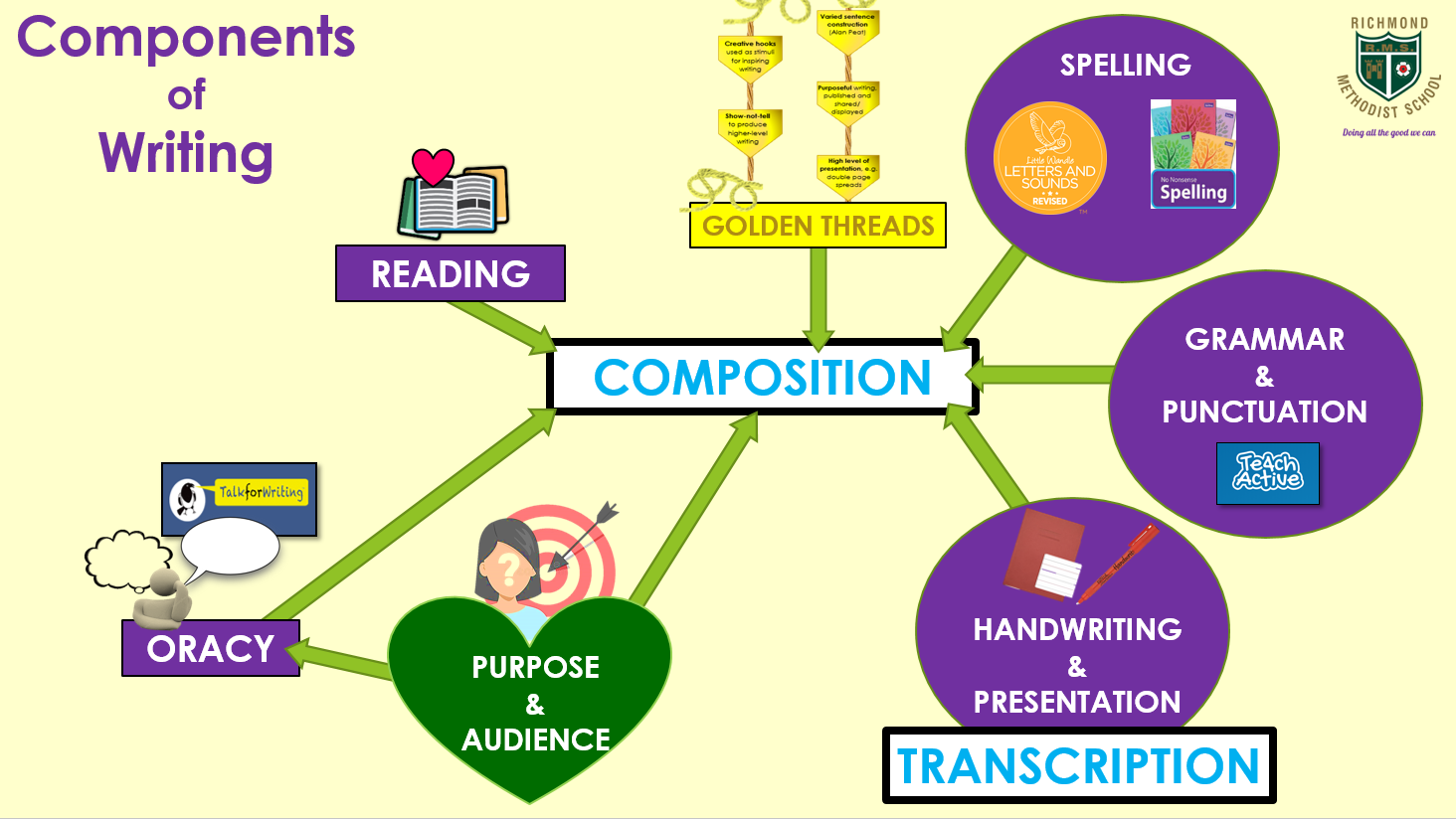
At RMS, we engage children in exploring and writing in a variety of styles and for differing purposes and audiences, using a rich and varied vocabulary. Children are taught to vary the structure of their sentences and to continue to increase the range of their vocabulary. We provide many experiences where children can develop their spoken fluency and ability to communicate independently. Grammar and punctuation skills are taught within the context of each lesson. We strive to teach the children to improve fluency and automaticity in the accuracy of writing and editing.
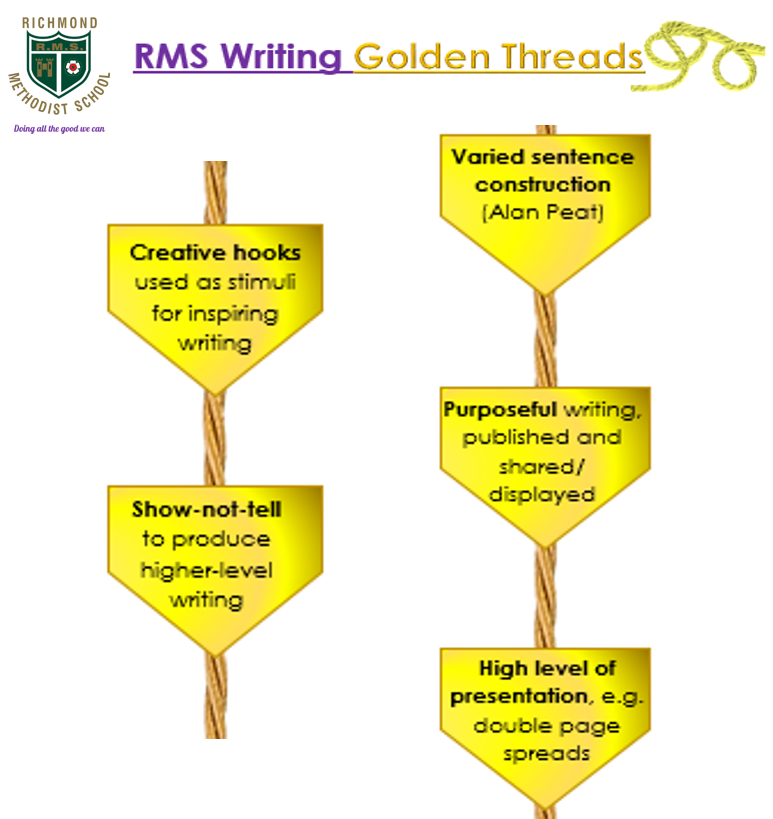
These RMS 'Golden Threads' are elements which run through all aspects of our writing lessons and outcomes.
Speaking and listening:
We place great emphasis on oracy across school. Children must first be able to articulate their sentences before they can translate their ideas accurately onto a page. Our children are exposed to high-quality, Standard English, modelled by their teacher. Children have lots of time for deliberate oracy practice, which may include discussion with a partner or group to orally develop their ideas, rehearsing sentences orally or a drama activity.
Foundations of writing:
We recognise that strong foundations for teaching writing are essential.
To be able to write, children are taught how to:
- sit correctly
- hold a pencil correctly
- form letters (handwriting)
- sound out spellings (decode)
- speak using standard English
- form sentences orally
- understand the meaning of words
Writing is promoted across our continuous provision activities in EYFS and KS1 and children are encouraged to write everything and anything which sparks their interest.
Talk For Writing:

At RMS, we teach writing based on an approach called ‘Talk For Writing’. ‘Talk for Writing’ is an engaging framework for teaching writing, based on the principles of how children learn. It enables children to orally imitate the language they need for a particular topic, before reading and analysing it, and then writing their own version.
Some of the core teaching practices and principles of Talk For Writing are:
- Use a strong model text
- Read and explore models attentively
- Teacher as model reader and writer
- Teach language needed orally as well as through reading
- Think aloud to explain
- Gradual release of responsibility (shared writing and guided writing before independent writing)
- Small steps, bit by bit
- Pitch it high and expect everyone to succeed
- Differentiate through scaffolding
- Lots of scaffolded practice where needed
At RMS, we teach writing in 3 stages, based on Talk For Writing:

Imitation phase: A creative ‘hook’ engages the pupils with a sense of enjoyment, audience and purpose. Teachers may provide a stimulus such as a film clip, interesting object, wordless picture book, visitor or visit as a starting point. The teacher will then share a model text with the children. The model text has built into it the underlying, transferable structures and language patterns that pupils will need when they are writing their own version. The model text is read for vocabulary and comprehension, before being analysed for the basic text and language patterns, as well as writing techniques or ‘ingredients’. This is sometimes learned using a ‘text map’ and actions to strengthen memory and help students internalise the text. Activities such as drama are used to deepen understanding of the text and the teacher provides plenty of opportunity to ‘rehearse’ the required vocabulary, grammar, sentence and text structure. ‘Short-burst’ writing is used to practise key focuses such as description, persuasion or explanation.
Innovation phase: Once students are familiar with the model text, then the teacher leads them into creating their own versions. A new subject is presented and the teacher leads students through planning. With younger pupils, this is based on changing the basic map and retelling new versions. Older students use boxed-up planners and the teacher demonstrates how to create simple plans and orally develop ideas prior to writing. Shared and guided writing is then used to stage writing over a number of days so that students are writing texts bit by bit, concentrating on bringing all the elements together, writing effectively and accurately. Feedback is given during the lessons, so that pupils can be taught how to improve their writing, make it more accurate, until they can increasingly edit in pairs or on their own.
Application phase: Children independently apply what has been taught and practised. Pupils are guided through planning, drafting and revising their work independently. Writing may be staged over a number of days. It is important that at the innovation and independent application stages, the writing becomes increasingly independent of the original model rather than a pale copy. Whilst four-year-olds may only make a few simple changes, older students should be adding, embellishing, altering and manipulating the original structure. From Key Stage 2 onwards, many children will be using the text structure and writing tools to write, drawing on the model, their wider reading and experience.
Click here to read RMS Writing Progression Overview
You can find out more about the Talk For Writing approach here:
https://www.talk4writing.com/about/
Spelling:
From the start of Reception up until mid-Year 2, our children are taught to use their phonic knowledge to spell words. We follow the ‘Little Wandle Letters and Sounds Revised’ systematic synthetic phonics scheme*, which actively teaches the children to use phonics as the only approach to decoding. Phonic decoding skills must be practised until children become automatic and fluent. Graphemes (a letter or group of letters used to represent a particular phoneme – sound) are taught so that children can transfer their sounds into written language.
* To find out more about ‘Little Wandle Letters and Sounds Revised’ please visit our ‘Reading’ page or go to https://www.littlewandlelettersandsounds.org.uk/resources/for-parents/
From mid-Year 2 onwards, on completion of all phonics phases, children are taught spelling through the ‘No Nonsense Spelling’ scheme. We believe that spelling should be ‘taught, not caught’ – children need to learn spelling patterns and rules, statutory words, common exceptions and personal spellings. ‘No Nonsense Spelling’ teaches spelling in a ‘Little-but-often’ structure, which allows children to revisit and review, learn new strategies (deliberate practice) and apply. A variety of strategies are suggested so that children with different learning styles can find out what works well for them. Handwriting activities are also included, to develop muscle memory of the spelling pattern. Spellings are sent home weekly and are required to be learned.
Click here to view ‘No Nonsense Spelling’ planning for Year 2
Click here to view ‘No Nonsense Spelling’ planning for Year 3
Click here to view ‘No Nonsense Spelling’ planning for Year 4
Click here to view ‘No Nonsense Spelling’ planning for Year 5
Click here to view ‘No Nonsense Spelling’ planning for Year 6
Impact – How does our children’s writing knowledge develop?
Our children write clearly, accurately and coherently, adapting their language and style in and for a range of contexts, purposes and audiences. They are equipped with a strong command of the written word and a high standard of literacy, which prepares them for secondary school and their life beyond education.