What is expected?
This information is intended to provide clarity and transparency to staff, pupils, parents or carers and Governors about what to expect from remote education where national or local restrictions require entire cohorts (or bubbles) to remain at home, which also applies where individuals need to isolate. Richmond Methodist Nursery and Primary School has the capacity to offer immediate remote education ‘for all’.
Remote education in Richmond Methodist Primary and Nursery School consists of high-quality, sequential live and recorded teaching and learning via Microsoft Teams, making flexible use possible in the context of limited or shared device access. We will continue to teach all or most of the normal planned curriculum in the remote environment, which remains underpinned by our vision of ‘doing all the good we can’. However, we have needed to make some adaptations in some subjects. For example, more practical subjects like art, design technology, computing, music and science. Knowledge and skills are built incrementally, with clarity about what is intended to be taught and practised in each subject. It will allow for daily meaningful interaction between adults and children, which provides not only ambitious learning but also effective assessment and feedback.
Our remote, restorative, and responsive curriculum will cover a broad and balanced range of subjects, providing frequent clear explanations of new content, delivered by a teacher in the school. Our programme of remote learning will build up to the equivalent length to the core teaching pupils would receive in school – three hours for EYFS and KS1 and four hours for KS2 - and include daily contact with teachers. Teaching will be differentiated and provide both support and challenge as appropriate, to meet the needs of all children.
Younger children and some children with SEND (Special Educational Needs and Disabilities) may not be able to access remote education without adult support so school will adapt teaching and learning materials accordingly to meet individual needs.
Our plan for remote education has been devised in consultation with staff and parents. We have evaluated what aspects of remote education went well in 2020 and we need to keep, what aspects to stop, what aspects we need to improve and what aspects we need to start delivering that we were not able to deliver last year.
A large part of our recovery curriculum will be supporting children, families, and staff in delivering, managing, and using high-quality, sequential remote learning via Teams. We will:
- share remote learning expectations with staff, parents and Governors.
- ensure all staff are trained and feel confident using Teams.
- support children and families to access remote education.
- loan school iPads and laptops for those families with limited access to devices or families with multiple siblings who are sharing devices.
- supply printed resources and workbooks, for pupils who do not have suitable online access or for our younger children or SEND pupils who may require different and additional resources.
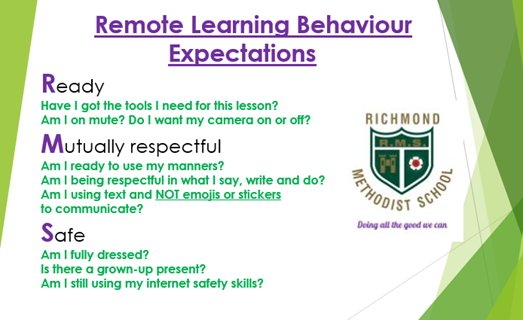
- establish ‘Remote Learning Behaviour Expectations’ around being ‘Ready, Mutually Respectful and Safe’, including expectations around being respectful, using mute, using camera, use of chat.
- Class Dojo and Tapestry will remain in use for communication, as our parents welcome this, and the communication element has already proved to be invaluable in summer term 2020. Teachers and parents will be able to message one another to share information and offer support. The Class Story page will offer the chance for teachers to celebrate children’s work and maintain our school community. Use of Class Dojo and Tapestry will be in-line with the Class Dojo and Tapestry Usage Policies.
- For children in Years 1 – 6, Teams will be for teaching and interaction and Class Dojo will only be used for sharing some resources/worksheets, communication and celebrating success. For children in Nursery and Reception, Teams will be used for teaching and interaction and Tapestry for observations, assessment, and messaging. We will continue to use Dojo and Tapestry in school when not in lockdown.
What Remote Learning will look like at RMS?
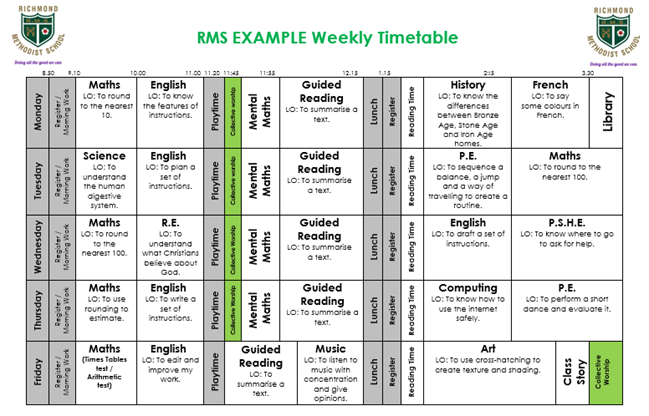
- Staff will set up a weekly timetable from September 2020– with a learning objective for each lesson. Teachers will differentiate the tasks into bronze, silver, and gold challenges. These will be sent home weekly so that parents are aware of the sequence of learning.
- All live lessons will be recorded to provide flexible access for families. MS Teams will support school in offering true online learning with the opportunity for children to communicate with staff – often in the form of ‘drop-in’ and feedback sessions following live teaching.
- Richmond Methodist Primary and Nursery School will provide daily live English and maths unput and ‘drop-in’ sessions – with short input from the teacher and then a period of supervision and opportunities for support, challenge and feedback. Sessions can be differentiated eg. L, M, H. One staff member from each team can lead a differentiated input or session inputs can also be whole class. White Rose Maths resources will be used, as they are matched to our current maths curriculum model.
- We will deliver daily phonics activities in N/R/Y1/Y2 (Y3 if required) – Differentiated sessions for each phase can be taught, using breakout rooms. These sessions should involve direct teaching of new sounds, to ensure accuracy of phoneme pronunciation and grapheme formation. Trained and skilled support staff can deliver phonics sessions.
- Weekly live whole class reading and guided reading sessions will take place for each child in line with our RMS Reading Blueprint. 1:1 reading for vulnerable children / our lowest 20% and reading interventions can all take place remotely. All staff will be involved in leading guided reading sessions and individual 1:1 reading (using breakout rooms). Children will have access to the Big Cat eBook Library, which matches our Guided Reading scheme in school. Staff will allocate eBooks at the correct level for children to read them at home.
- We will deliver a broad and balanced curriculum which does not over-rely on long-term projects and on-line research. Foundation subjects (and science) will be taught weekly with one live input daily. Eg. Monday – Science, Tuesday – History, Wednesday – Art/DT. This will include live teaching then period of supervision for feedback/questions. We will deliver two sessions of PE and encourage daily activity – which can include on-line sessions. KS1 (and EYFS) will offer a home accessible continuous provision model (e.g. Rainbow Challenges KS1). These will be independent learning challenges the children can flexibly complete in non-directed time during the school day.
- We will gauge how well pupils are progressing through the curriculum through questioning and providing feedback, checking work throughout the daily live teaching session. We will ask parents to share high quality photographs of work. These can be ‘liked‘ to demonstrate they have been seen rather than a comment written, unless teachers feel this is necessary. When using work from home as an assessment, we will ensure we are aware of the level of adult scaffolding. We may ask parents to show the help they have given. The questions children ask in a Teams ‘chat’ can help gauge children’s understanding and additional support that may be required.
- We will support children’s positive mental health and wellbeing and allow for social interaction between peers through supervised Teams playtimes, supervised by support staff. Each class will be divided into four playtime groups – that include friendship groups. Support staff may, if necessary, provide a smaller playtime group for vulnerable children.
- PSHCE will be core to our recovery curriculum to promote positive mental health and wellbeing. We will ensure that there is regular, direct teaching of PSHCE with opportunities to follow the planned curriculum AND in response to the social and emotional needs of children.
- Mental and physical wellbeing is a priority for our whole school community. As such, school staff will plan to break up lessons and ‘screen time’ by encouraging physical activity and breaks between lessons. Staff could provide links to online physical activity/mindfulness eg. Joe Wicks, Cosmic Yoga.
- Collective Worship will take place twice weekly via Teams – 11am on Mondays and Fridays. Fridays CW will be our Celebration Assembly. Rachel Pinkney will also record one assembly per week to be shared by the class teacher.
- We will plan for and teach internet safety in week one of every half term and revisit regularly.
- Staff will monitor pupil engagement via Teams and work submitted on Class Dojo/Tapestry and contact families to provide additional support if required. Staff should monitor engagement overtime by completing a register or downloading a list from participants.
- RMS has taken steps to build safeguarding into our remote education set-up. Chat and email functions have been disabled in Teams for all children. Parents have signed a Teams user agreement and behaviour expectations will be embedded into remote learning activities. Our usual safeguarding policy and method of reporting on CPOMS applies at all times.
- On a weekly basis we will record the percentage of engagement in live learning and the percentage of engagement by returning completed work for each year group. Senior leaders will monitor engagement over time.
- Richmond Methodist School expect regular engagement in remote learning and if class teachers have not had any engagement during a school week (either in live learning or by returning work), then they will contact parents via Class Dojo, then via a phone call home to check-in and provide further support for remote learning. Staff will use CPOMS to report concerns if there has been no engagement for one week.
- Our SENCO will check in with our vulnerable families weekly and support engagement and the Headteacher will contact families whose engagement is a cause for concern via phone call or doorstep visit.
- Our SENCO will contact Children’s Social Workers and Early Help team at the start of a period of local or national lockdown (or when a vulnerable child needs to isolate) to discuss the support provided by the school and agree a risk assessment.
- PPA (Planning Preparation and Assessment) can be done remotely and will take place on Wednesday pm for Year 3 / 4, Thursday pm for Year 5 / 6 and Friday for Year 1 / 2 and EYFS (Early Years Foundation Stage).
- SLT meetings will take place remotely, Wednesdays 4.30pm – 5.30pm.
- Staff meetings will take place remotely, Tuesdays 4.30pm – 5.30pm.
- Meetings will only take place when required for urgent and essential business and staff will be encouraged to attend these virtually at home.
- School will direct parents to Oak Academy for daily learning activities, in the event that a class teacher is unable to plan and deliver remote education.
- If children or parents themselves are too ill, then they should let their child’s class teacher know and there will be no expectation to engage in remote learning.
Feedback During Remote Learning:
- Our techniques for feedback during periods of “remote learning” align with our in-class practices.
- Teaching staff give whole-class verbal feedback during live lessons on Teams. They give feedback to groups or individuals by using breakout rooms.
- Teachers gauge how well all pupils are progressing through questioning.
- Teachers give feedback and assess progress daily.
- Children’s work will be uploaded by parents onto their child’s Class Dojo and Tapestry portfolio to be monitored and approved by the teacher. This will inform teachers of next steps in learning.
- For children unable to access live feedback, teachers can communicate with them using Class Dojo, Tapestry or via a phone call.
Supplementary Work:
- Children with Lexia log in do this daily and staff can monitor progress.
- Set a weekly sum dog task for all children in Y1 – Y6.
- All children have a Big Cat eBook Library login, enabling them to read books at their level from home.
- Children and parents will be signposted to the ESafety page on our school website. Children will be encouraged and reminded regularly how to stay safe online.
- Continuous provision challenges for children in the Early Years and Key Stage 1 (Rainbow Challenges).
Logistics for Critical Worker and Vulnerable Learner Bubbles in school:
- Our CW/V bubbles will be taught and staffed by teaching and support staff combinations who usually teach in those age ranges to minimise close contacts in line with our Risk Assessment.
- Teaching staff will focus on leading on-line learning, assessment, and feedback for all children, including critical worker/vulnerable children. Support staff will lead sessions and support smaller groups/individuals with engagements and closing the gap activities.
Our approach to remote learning will follow the current school timetable but may be adjusted (and continually reflected on) to safeguard staff and children’s physical and mental well-being over time.
KS1
8.40 -11.30 Core Subjects including movement breaks
11.30-12.30 lunch
12.30 Short input followed by Foundation Subject Rainbow Challenges
(No expectation for staff for staff to be available online)
2.30- 3.00 End of day activity (e.g., story, sharing time)
KS2
9,00/9.15 -12.30 Core subjects including movement breaks
12.30-1.30 lunch
1.30- Foundation Subject (inc. Science) Input followed by Independent Learning Challenges. There is no expectation for staff to be available on-line.
3.00 - 3.30 End of day activities for children in school and at home (story/circle time / sharing work)
Appendix 1
From 8th January 2021 the Department for Education’s expectations are that schools:
- set assignments so that pupils have meaningful and ambitious work each day in a number of different subjects
- set work that is of equivalent length to the core teaching pupils would receive in school, and as a minimum
- EYFS and KS! 3 hours a day, on average, across the school cohort
- KS2: 4 hours a day across the cohort
- provide frequent, clear explanations of new content, delivered by a teacher or through high-quality curriculum resources or videos
- have systems for checking, at least weekly, whether pupils are engaging with their work, and inform parents immediately where engagement is a concern
- gauge how well pupils are progressing through the curriculum using questions and other suitable tasks, and provide feedback, at least weekly, using digitally facilitated or whole-class feedback where appropriate
- enable teachers to adjust the pace or difficulty of what is being taught in response to questions or assessments, including, where necessary, revising material or simplifying explanations to ensure pupils’ understanding