Please click here to view the Two year curriculum overview for R.E
Religious Education
Intent
In line with our Methodist character, we welcome all to our school and our Religious Education curriculum is ‘for all’.
We aim to
…engage all children in systematic enquiry into significant human questions which religions and world views address, so that they can develop the understanding and skills needed to appreciate and appraise varied responses these questions, as well as develop responses of their own.
(Taken from the North Yorkshire Agreed Syllabus for Religious Education 2024-2029)
Our Religious Education gives us the opportunity to reflect on ways of living where we can ‘do all the good we can’, developing our individual ideas, values and identities. We use the teaching of religious and non-religious world views to inform our knowledge so as to better understand the influences on ourselves and our communities.
We enable children to have the necessary knowledge, constructed systematically to consider the different answers to the challenging questions about the meaning and purpose in life, beliefs about God, ultimate reality, issues of right and wrong and what it means to be human.
Our curriculum enables all children to know about and understand a range of religious and non-religious world views. Our children will be able to describe, explain and analyse beliefs and practices, recognising the diversity which exists within and between communities and amongst individuals. They will be able to identify, investigate and respond to questions posed, and responses offered, by some of the messages found in religious and non-religious world views. Our children will appreciate and appraise the nature, significance and impact of different ways of life and explore ways of expressing meaning.
We want our children to be able to express their ideas and insights about the nature, significance and impact of religious and non-religious world views. They should be able to explain, using reasoned arguments, their ideas about how beliefs, practices and forms of expression influence individuals and communities. Children will be able to express with increasing reasoning their personal reflections and critical responses to questions and teachings about identity, diversity, meaning and value, including ethical issues. They should be able to appreciate and appraise varied dimensions of religion.
We aim for children to gain and deploy the skills needed to engage seriously with religious and non-religious world views. We want them to investigate key concepts and questions of belonging, meaning, purpose and truth, responding creatively. Children will enquire into what enables different individuals and communities to live together respectfully for the well-being of all. They will articulate clearly beliefs, values and commitments in order to explain why they may be important in their own and other people’s lives.
This understanding builds and connects us ‘all’ in a shared cultural capital, increasing respect and celebrating the diversity of ‘all’.
Implementation
We focus not only on the substantive knowledge, but ways of knowing and understanding the perspective or personal view of each of us. We recognise too that there is diversity within each world view and so when we teach substantive knowledge, we seek to widen so there is not a lens of generalisation for each world view, religious or non-religious, organised or individual.
We teach R.E. weekly and discretely through a mixture of practical and academic exercises. We use foundational texts, beliefs, rituals, and practices and explore how these aspects help us form identity in a range of religions and worldviews. We learn change in different times, places and cultures. Children are taught R.E. as a theological, sociological study of religious phenomena but also we recognise it is cross curricular and we will teach some aspects, for example philosophy and existentialism in our human and social sciences. We also encourage children’s creative responses to the development of their personal worldview.
Our R.E. substantive knowledge is underpinned by the following:
Spiritual development
We foster awe and wonder, making time to be mindful, reflective and in the moment. Our children are given opportunities to appreciate the possibilities of there being something or someone beyond ourselves, which religious World Views name as God/Gods but could be Mother Nature or the Universe for instance. We offer opportunities for children to reflect on their own ideas and how they may be informed, as well as the view of others. We ask big, critical questions and foster a natural curiosity towards things that are important to us. Children will work together, collaborating and investigating, agreeing, building on or challenging their ideas. We teach that our shared values construct a shared spirituality. With examples of fairness and respect, compassion and generosity, we inspire each other but also tenacity and service, education and perseverance will be explored in real contexts. Above all, children will be encouraged to appreciate and to notice by exploring some of the marvels and mysteries of the natural world, of human ingenuity, and examples of the capacity of humans to love, create, organise and overcome adversity.
Moral development
The development of strong values, both individual and shared enables children to appreciate the uniqueness of all humans and their moral value, and to act in the world and to others accordingly.
Teamwork, trust and empathy will be taught and nurtured. Moral questions will be posed to allow a safe space for children to explore their ideas of right and wrong, moral dilemmas and explore case studies where the Christian values are practiced. Moral connections with others will be established through role play, debates or whole school projects, however, in situations where there are disagreements will also be explored so children learn that their right of expression is balanced by a responsibility to listen to the views of others. We respect the rule of law.
Social development
We use a range of language and communication skills. We all have a voice. We participate in the local community. We appreciate diverse viewpoints. We participate, volunteer and cooperate. We empathise to develop strategies to resolve conflict and learn the value of democracy. We strive towards understanding and so we promote peace and harmony. We explore the more abstract concepts which bind our communities together, such as justice, fairness, honesty and truth. We investigate sources of thought, belief and ideas to better understand social and behavioural norms. We examine the media and political or social issues which may change behaviours. We find appropriate role models, locally, nationally and internationally to inform our behaviours and relationships. We go on school trips, invite visitors in and use drama or art to experience different representations.
Cultural development
We appreciate our shared culture and explore fully our together heritage. Our History is an important part of our present and future. We look for links, causes and effects. We learn about other World Views, celebrating both similarities and differences. We celebrate diversity whilst cherishing community. Together, we share in as many cultural opportunities as possible.
We teach our R.E. through an enquiry approach where we ask questions to increase our knowledge and make connections between themes and perspectives. We use challenging questions of meaning and purpose raised by human existence and experience.
As a Church School, we teach a rich, deep knowledge and understanding of Christian belief and practice, and this includes the ways in which it is unique and diverse.
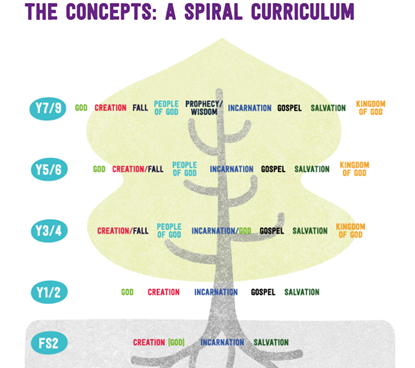
Our Christian concept blocks are sequential, progressing across a year and vertically through the school.
- We make sense of a religious text, piece of art or music: developing pupils’ skills of interpretation; understanding how Christians interpret, handle and use biblical texts and other resources; making sense of the meanings of these aspects for Christians.
- We Understand the impact: examining ways in which Christians respond to biblical texts and teachings, and how they put their beliefs into action in diverse ways within the Christian community and in the world.
- We connections: evaluating, reflecting on and connecting the texts and concepts studied, and discerning possible connections between these and pupils’ own lives and ways of understanding the world.
Impact
Through our Religious Education and our SMSC learning, we aim to improve academic standards but also create an equality of opportunity ‘for all’ and maximize our children’s life chances.
We build a cohesive, harmonious community ‘for all’ through a well-rounded understanding of, and respect for, both self and for others.
Our children leave KS2 able to look back on a secure, engaging and happy primary education and can be proud of their successes. They are able communicators, responsible citizens and resilient life-long learners. We want them to be confident that they have always done ‘all the good they can’ and will continue to do so.
They will have made and be good friends, making friendships that will endure. The children will be able to encourage others – when necessary and have leadership skills, but above all, be interested in the world around them and keen to make a positive contribution to society. We hope that they will be willing to share and reflect upon their own and other’s perspectives and thoughts, be able to work with others, without prejudice, understand changes and be eager for challenge. They will see the wonderful world as ‘for all’ and will have the secure foundations to begin to understand their place in it.
We will see evidence of the success of our curriculum, not only through our monitoring but through the personal development of our children. It will be evident in their relationships, their behaviours and their sense of civic responsibility.
During their time in school children take part in acts of collective worship.
It should be noted that parents have the right to withdraw their children from RE teaching and should contact the headteacher should they wish to do so.